Recently, a team led by Professor Shi Jinhui from the College of Physics and Optoelectronic Engineering at Harbin Engineering University, in collaboration with the Shanghai Institute of Technical Physics (Chinese Academy of Sciences), National University of Singapore, Jinan University, Guizhou Minzu University, and East China Normal University, has made a significant breakthrough in the field of chiral optics. The team proposed a novel metasurface structure that achieves a robust, ultra-high quality-factor chiroptical response. This achievement provides new insights for the practical application of high-performance chiral photonic devices, ultra-sensitive chiral sensors, and nonlinear optical devices.
The findings were published in the top-tier optics journal “eLight” under the title "Robust chirality via merging accidental BICs with net zero topological charge." Doctoral student Hu Hui (Class of 2021) from the College of Physics is the first author of the paper. Professors Shi Jinhui, Qiu Chengwei, Li Guanhai, Deng Zilan, and Huang Lujun are the corresponding authors. Harbin Engineering University is the first affiliated institution.
Chirality refers to the structural property of an object that cannot be superimposed onto its mirror image, just like our left and right hands, which are mirror images but cannot completely coincide. Chiral substances are ubiquitous in nature, such as DNA, proteins, organic molecules, shells, and galaxies. Studying how light interacts with these chiral substances—known as chiral optics—is of great significance for drug development, disease diagnosis, and even exploring the origin of life. Circular dichroism is commonly used to measure the strength of this interaction, reflecting the differential response of chiral substances to left- and right-handed circularly polarized light. To enhance chiroptical response, scientists have turned to a new frontier in optics: bound states in the continuum (BICs), a very peculiar optical state. This optical state acts like a perfect "optical cage" that can firmly "trap" light energy within a micro/nano structure, thereby greatly enhancing light-matter interaction. By utilizing BICs, one can achieve strong circular dichroism and an ultra-high optical quality factor (a measure of the degree to which light is confined). However, previous approaches faced an insurmountable bottleneck: poor robustness of the chiroptical response, which was extremely sensitive to the incident light angle and structural parameters. Minute changes in angle or structure would lead to a dramatic decline in performance, severely limiting the practical application of chiral photonic devices.
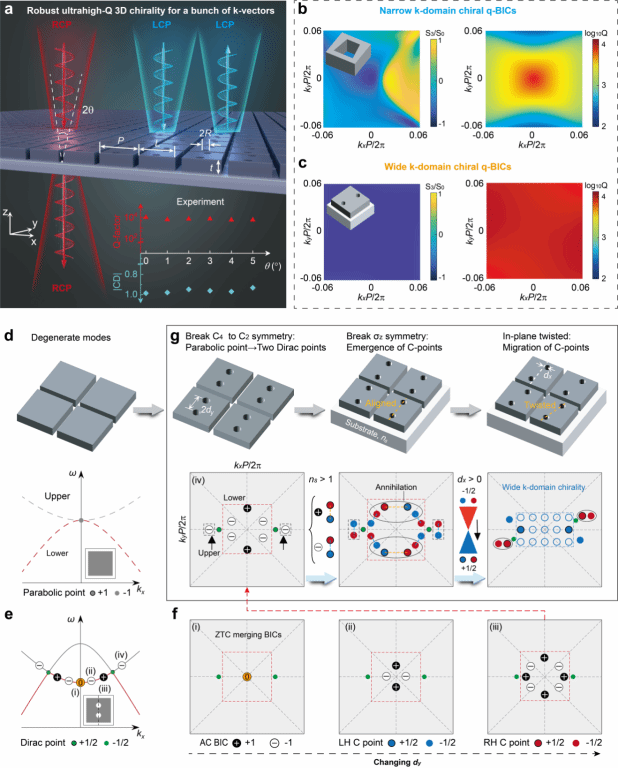
A wide-momentum-domain chiral metasurface based on merging BICs with net zero topological charge.
To address this challenge, the research team proposed a "merging BICs with net zero topological charge" mechanism. Starting from a highly symmetric single-layer silicon metasurface, through meticulous topological charge manipulation, they ingeniously extended the chiral response, originally confined to a specific incident angle, to a broad and stable angular space, creating a "chiral safe zone" within ±5° of the incident light. Experiments confirmed that within this zone, the metasurface simultaneously possesses an ultra-high optical quality factor (on the order of 10⁴) and near-100% circular dichroism. The outstanding optical performance demonstrated by this achievement is expected to provide crucial support for cutting-edge directions such as high-sensitivity substance detection, on-chip photonic control, and optical information processing.
“eLight” focuses on cutting-edge and interdisciplinary directions in optics, photonics, and electromagnetics. Co-published by Springer Nature and Light Publishing Group, it is selected for the Excellence Action Plan for China STM Journals and is a double-first-rank TOP journal in both the physics and astrophysics category and the optics category. With a 2025 SCI impact factor of 32.1, it ranks second globally in the field of optics, just behind “Nature Photonics” (impact factor 32.9).
Paper Link:
Hu, H., Zhou, C., Zhang, Y. et al. Robust chirality via merging accidental BICs with net zero topological charge. eLight 6, 12 (2026).
https://doi.org/10.1186/s43593-026-00126-z