At the beginning of the 2026 spring semester, the "First Lecture of the Semester" for “College Physics” at Harbin Engineering University arrived as scheduled, once again igniting the scientific enthusiasm of the entire faculty and student body. This lecture was jointly organized by the College of Physics and Optoelectronic Engineering and the 717th Research Institute of China State Shipbuilding Corporation Limited, with Project Lead Le Xuguang specially invited as the keynote speaker. Researcher Le Xuguang is the Project Lead of the Cold Atom Inertial Navigation Center at the 717th Research Institute of CSSC, deeply engaged in the fields of cold atom physics and quantum precision measurement. He has participated in multiple major research projects, presided over a project of the Young Scientists Fund of the National Natural Science Foundation of China, and received honors including the Special Prize for Scientific and Technological Progress of CSSC.
The event was hosted by Jiang Haili, Deputy Dean of the College of Physics and Optoelectronic Engineering, who emphasized the importance of fundamental research and delivered a message to all students: "I hope you will seek macroscopic truth amid microscopic uncertainty and establish your life's coordinates among numerous variables. With patriotism in your hearts, combine the ideal of looking up at the stars with the rigor of being down-to-earth, set sail in the ocean of physics, and measure the deep blue with your youth!"
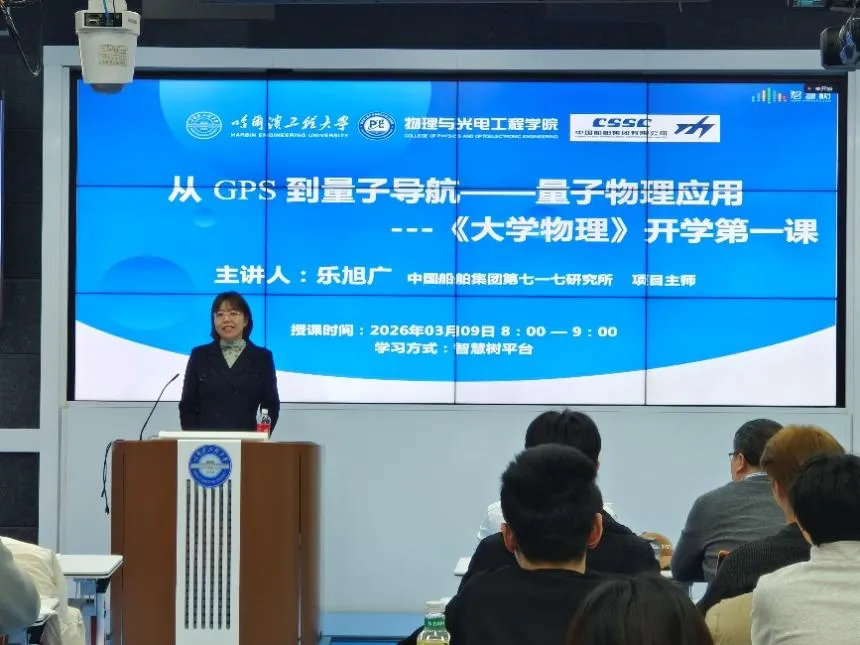
Le Xuguang gave a lecture titled “From GPS to Quantum Navigation—Applications of Quantum Physics”, broadcast live via the Zhihuishu Network, guiding thousands of teachers and students through a century-long quantum history and straight to the frontiers of "bottleneck" technologies in the field of national positioning and navigation. In the lecture, starting from basic concepts of quantum mechanics, Le Xuguang introduced the fundamental principles of several quantum precision measurement technologies, the difficulties encountered during their realization, and corresponding solutions, demonstrating the transformation process from physical concepts to technological implementation. Integrating the development of domestic satellite navigation technology and addressing scenarios where satellite navigation fails, such as underwater, underground, and deep space, Le Xuguang proposed a quantum PNT (Positioning, Navigation, and Timing) solution, which holds significant strategic importance. It can achieve precise, autonomous, and long-term stable navigation capability without relying on external signals, serving as the "eyes" and "brain" of a great power's critical instruments in extreme environments.
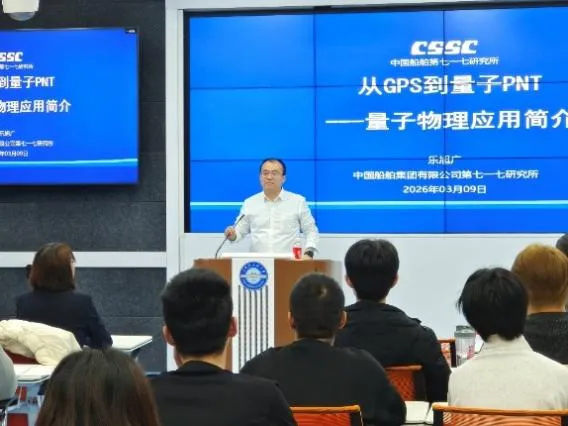
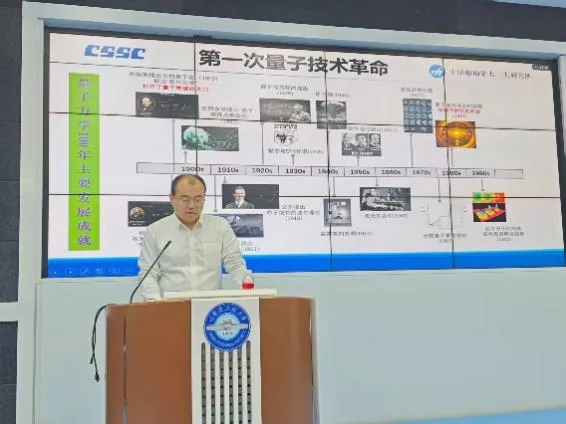
The entire session was rich in content, combining theoretical depth with cutting-edge science and technology. Approximately 1,600 students across 18 classrooms, together with their course instructors, entered the fascinating world of physics and experienced the charm of scientific research.
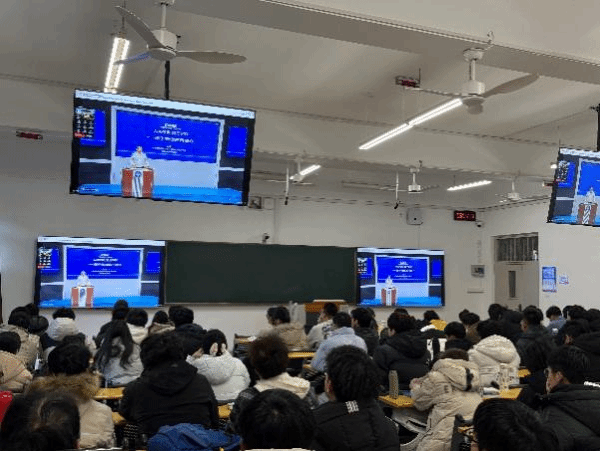
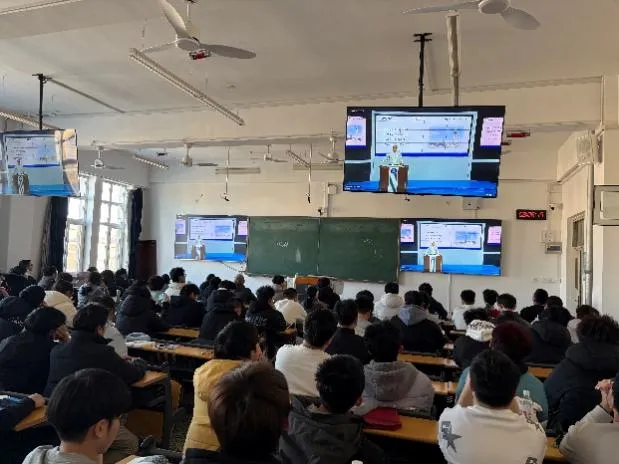
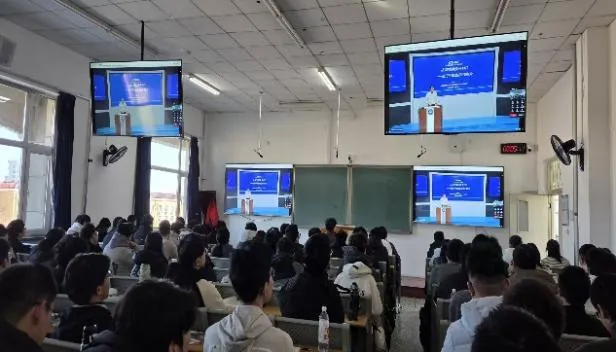
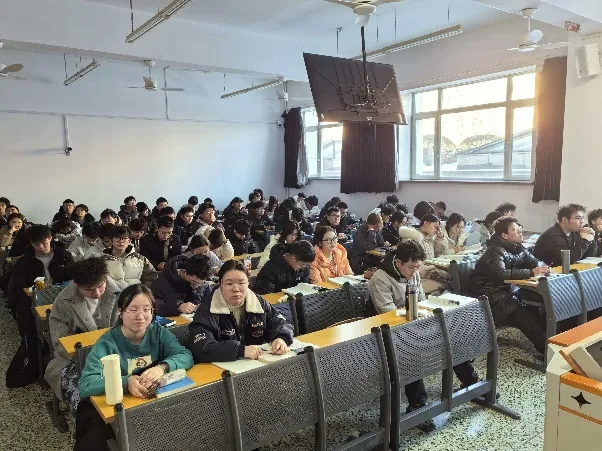
The first lecture of this semester also attracted attention from various colleges. Professor Zhang Yonggang, Dean of the College of Information and Communication Engineering, highly recognized the content and format of the first “College Physics” lecture: "The first lecture of the ‘College Physics’ course offered by the College of Physics is a pragmatic measure to reinforce the cornerstone of engineering talent. This initiative breaks the pattern of basic courses focusing heavily on formulas while neglecting background, concretizing and missionizing abstract theories by introducing great-power heavy instruments and frontier science and technology. It not only builds a macroscopic cognitive framework from classical to quantum for engineering students but also deeply plants the value gene of 'serving the nation through science and technology' right at the beginning of their university life. Such a high-starting-point instructional design effectively stimulates students' intrinsic motivation and injects strong spiritual drive and innovative potential into their subsequent professional studies."
After watching the lecture, “College Physics” instructors also shared their reflections.
Young faculty member Chai Quan: "As a lecturer, I have been pondering a question over the past two years: Under the context of Emerging Engineering Education, how should “College Physics” be taught? Mr. Le's first lecture of the semester has inspired me on how to guide students from basic concepts to practical engineering problems, so that they no longer fear formulas or physics. In future teaching, I will also intersperse some scientific research project experiences and engineering scenarios into the classroom, making it easier for students to understand the connection between physics and their own majors."
Young faculty member Zhang Mingsi: "This was an academic feast full of enlightenment and inspiration. In my future teaching, I will integrate this cutting-edge knowledge into classroom instruction, help students understand the development trends of physics, encourage them to actively participate in scientific research activities, and contribute to the advancement of physics. The report 'From GPS to Quantum Navigation' is like a beacon illuminating the path forward in my physics teaching and research."
Newly appointed faculty member Ye Jiaxuan: "As a physics teacher who just joined Harbin Engineering University, the greatest takeaway from listening to today's first ‘College Physics’ lecture was not the knowledge points themselves, but gradually figuring out how to truly bind ‘College Physics’ teaching with our university's 'Three Seas and One Nuclear' characteristic. In future classes, I will anchor cases to the 'Three Seas and One Nuclear,' coordinate cross-college lesson preparation, and let students see the practical utility of physics."
Through this unconventional and frontier-focused lecture, students gained a deeper understanding of the fundamental role physics plays in driving scientific and technological innovation and development, and it also inspired their aspirations to serve the country through science and technology. By integrating personal ambitions into the national cause of fully building a modern socialist country, the students further strengthened their resolve to strive for the realization of the Chinese Dream of the great rejuvenation of the Chinese nation.
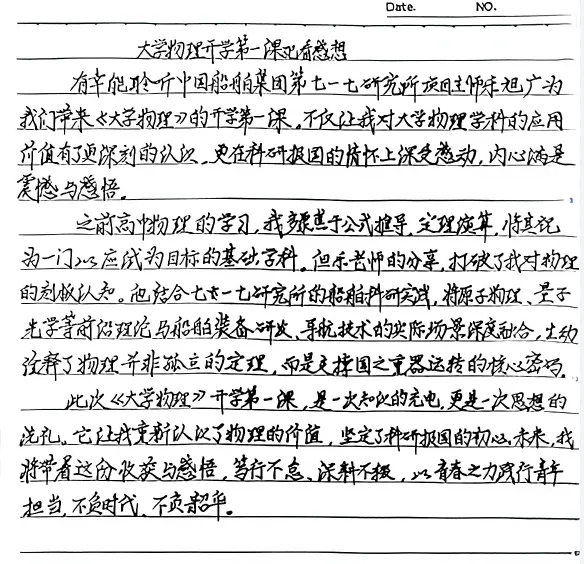
Undergraduate student Yu Minghan: "I was honored to attend the first ‘College Physics’ lecture delivered by Le Xuguang, Project Lead of the 717th Research Institute of CSSC. It not only gave me a deeper understanding of the application value of the university physics discipline but also deeply touched me with the sentiment of serving the nation through scientific research, filling me with inspiration and insight. In my previous high school physics study, I mostly focused on formula derivation and theorem calculations, treating it as a foundational subject aimed at exam-taking. However, Mr. Le's sharing shattered my stereotypical perception of physics. By integrating the scientific research practices of the 717th Research Institute, he deeply merged frontier theories such as atomic physics and quantum optics with practical scenarios in ship equipment research and development and navigation technology, vividly illustrating that physics is not an isolated set of theorems but the core code underpinning the operation of great-power heavy instruments. This first ‘College Physics’ lecture was a recharge of knowledge and, more importantly, an ideological purification. It helped me rediscover the value of physics and strengthened my original aspiration to serve the nation through scientific research. In the future, I will carry these gains and insights with me, remain diligent and persistent, deeply engaged and unwavering, and fulfill the responsibility of youth with youthful strength, living up to the times and the prime of my life."
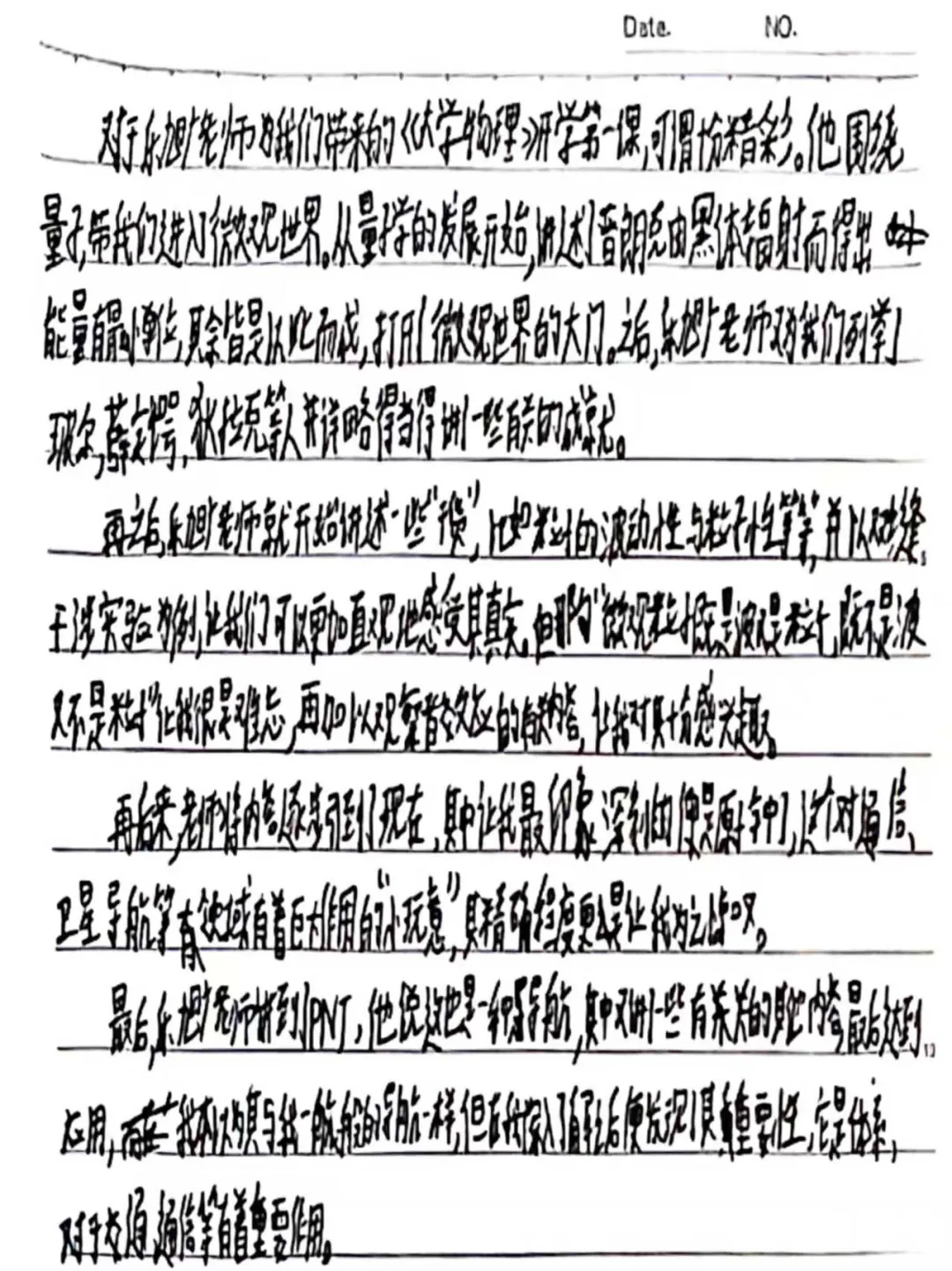
Undergraduate student Qiang Zhuojian: "The first ‘College Physics’ lecture brought to us by Mr. Le Xuguang was truly splendid. He guided us into the microscopic world around the topic of quantum. Starting from the development of quantum science, he recounted how Planck derived the smallest unit of energy from blackbody radiation, upon which subsequent developments were built, opening the door to the microscopic world. Afterwards, Mr. Le cited figures such as Bohr, Schrödinger, and Dirac, giving a well-balanced explanation of some relevant achievements. Then, Mr. Le began to deliver some 'solid substance,' such as the wave nature and particle nature of particles, and used the double-slit interference experiment as an example to allow us to perceive its reality more intuitively. But the statement 'microscopic particles are both waves and particles, yet neither waves nor particles' was very memorable, and coupled with related content about the observer effect, it fascinated me greatly. Later, the lecturer gradually brought the topic to the present, among which the most impressive to me was the atomic clock, a 'small gadget' of enormous significance to fields like communications, satellites, and navigation, and its precision left me in awe. After listening to Mr. Le's explanation of PNT, I initially thought it was not much different from ordinary navigation technology. However, as my understanding deepened, I gradually realized its true value. PNT is not just a technology but a system, playing a vital supporting role in areas such as transportation and communications."