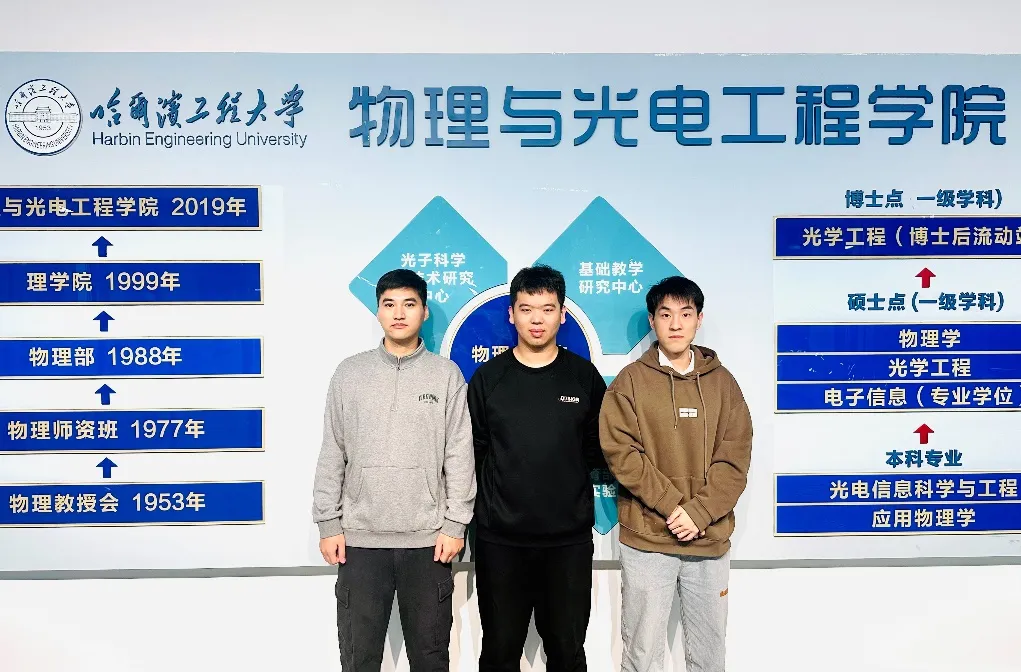
Recently, the 19th "Challenge Cup" "AI +" Special Competition concluded at Nanjing University. The project titled Silent Deep Vision – Pioneer of a New Generation of Low-Cost High-Precision Underwater Perception, led by our school’s postgraduates Dou Xinyu, Song Yeshuai and Wang Jianwei, won the National Third Prize in this competition.
This competition is co-sponsored by the Central Committee of the Communist Youth League, the China Association for Science and Technology, the Ministry of Education, the Chinese Academy of Social Sciences, the Chinese Academy of Engineering, the All-China Students' Federation, and the People's Government of Jiangsu Province. It has attracted more than 400,000 works from over 2,700 universities nationwide, involving more than 3 million students. The "AI +" Special Competition, held for the first time this year, aims to address the country's major strategic needs and cutting-edge scientific and technological issues. Starting from the requirements of safeguarding and improving people's livelihood and creating a better life for the people, it gives full play to students' academic strengths and supports the in-depth vertical development of "AI +" through the integration of artificial intelligence technology with various industries.
Guided by Professor Li Hanyang, the project leverages the advantages of Fiber Bragg Gratings (FBGs), including high sensitivity, electromagnetic interference resistance, and distributable array configuration. Combined with a demodulation link, it achieves high-precision measurements, and is more conducive to forming a lightweight and scalable underwater perception system compared to traditional acoustic/electromagnetic solutions. Meanwhile, adopting domestic optical fibers and self-developed deep learning algorithms, the project addresses the demand for real-time monitoring and recognition in complex underwater environments, balancing cost and reliability. It independently develops an underwater target recognition system — "Silent Deep Vision" — featuring high flexibility, high stability, meticulous precision, and three-dimensional positioning.
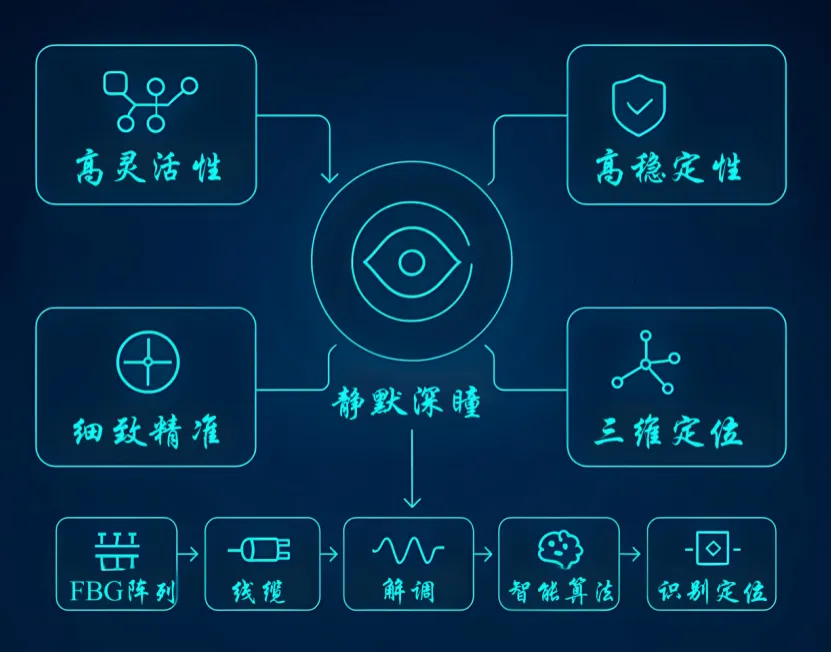
In the early stage of the project, the team addressed issues such as inadequate modeling of underwater background noise, repeated revisions to sensor packaging and waterproof/pressure-resistant solutions, and complex coupling between array geometric layout and demodulation algorithms. They optimized solutions one by one, and after multiple rounds of demonstration and iteration, finally adopted an FBG sensor array as the front-end perception module. By demodulating the flow field disturbance data detected by the array and combining with a self-developed graph neural network algorithm for signal feature extraction, the system achieves recognition and positioning of moving targets in the flow field, forming an integrated solution of "FBG array + demodulation system + intelligent algorithm + visual display."
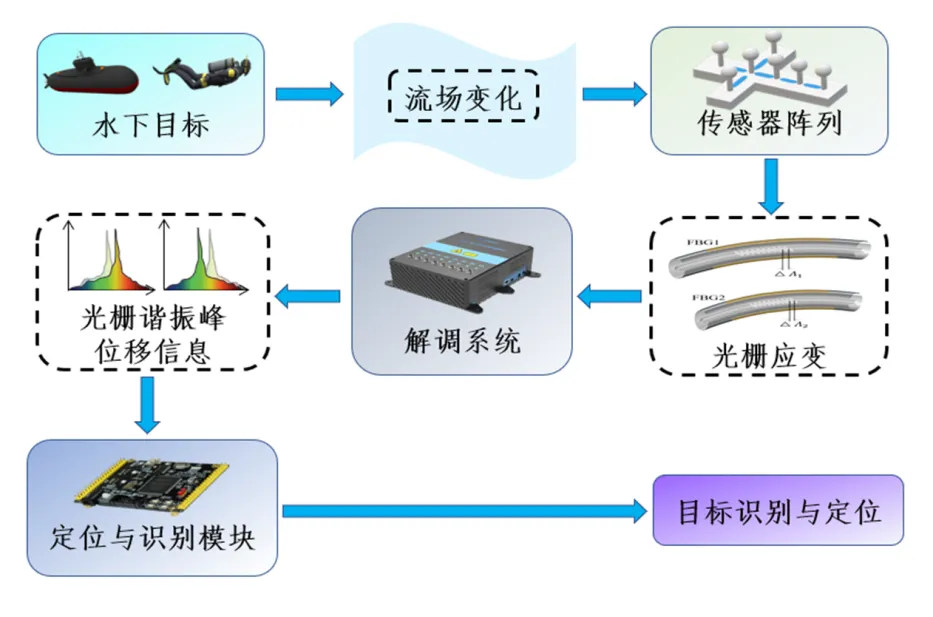
In addition, the project has optimized the entire link from "array terminal – cables – demodulation – algorithm terminal" based on systems engineering. Under complex background noise conditions, the system can still extract effective target features from noise to achieve stable recognition and positioning.
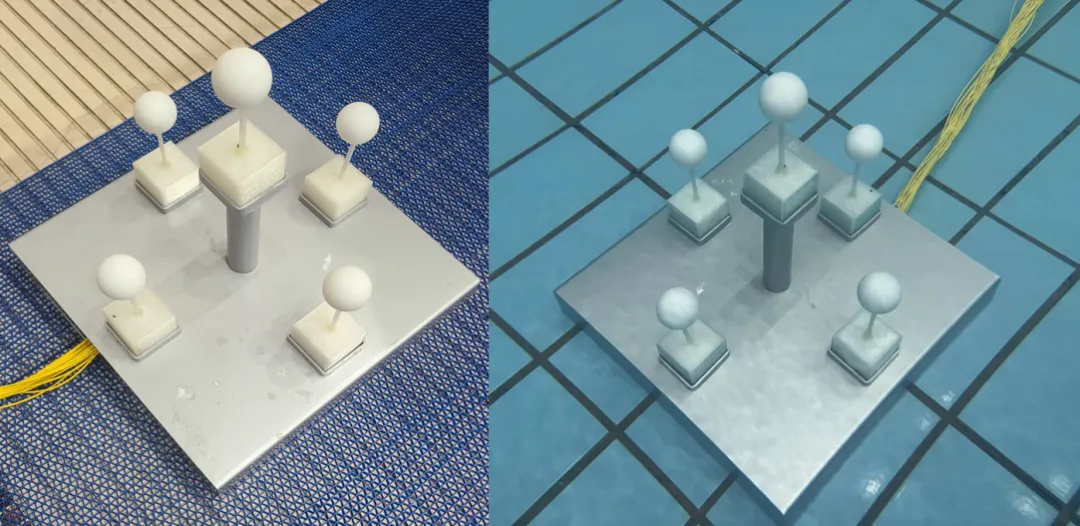
Through repeated testing, verification, and data analysis, the team's entry "Silent Deep Vision" has not only validated the technical route featuring low cost, high precision, and strong anti-interference capabilities but also enabled the team to take a solid step forward in engineering and scenario-based applications. Moving forward, the team will continue to deepen research around three core themes: "high precision, strong stability, and wide adaptability." Firstly, it will enhance the stability of recognition and positioning in scenarios with strong noise and weak echoes; secondly, it will promote the miniaturization, low power consumption, and long-term stability testing of prototypes; thirdly, it will improve multi-point collaboration, differential anti-noise technologies, and scenario-based deployment strategies to serve key applications such as port security, waterway supervision, and marine monitoring.
When asked about the team's future outlook, the members stated that this award is not an end but a new starting point. The team will focus on addressing the "bottleneck" technologies in scientific research and manufacturing, adhere to the principles of rigor and pragmatism, tackle key challenges proactively, and ensure that each iteration is grounded in verifiable indicators and replicable solutions. They will respond to the demands of the times with more reliable high-precision underwater perception capabilities, actively explore more practical technologies, and contribute the wisdom and strength of young people in the new era to the development of national innovative technologies.
Since the full launch of preparations for the "Challenge Cup" Competition, the school has attached great importance to it. Through extensive mobilization and integration of advantages, it has organized students to actively participate in the competition, gathered expert resources from inside and outside the university, provided in-depth guidance and optimization for the project, and enhanced the team's competitiveness. In the future, the school will transform the successful experience of this competition into a long-term driving force, further promote the innovation and reform of the innovation and entrepreneurship education model, integrate the cultivation of practical abilities and innovative spirit into the entire process of talent training, and contribute to the high-quality development of the school and the university.