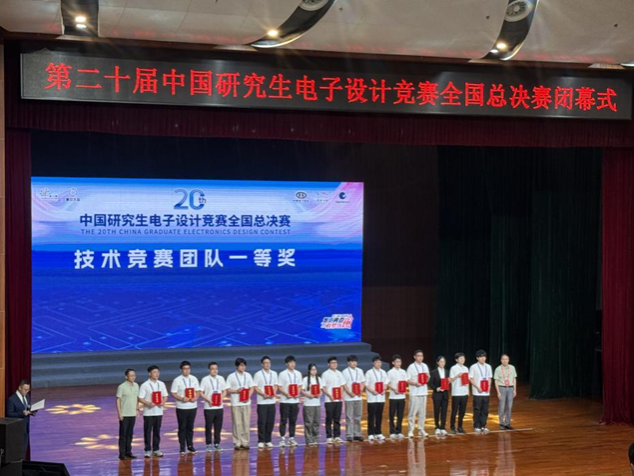
Recently, the National Finals of the 20th China Postgraduate Electronic Design Competition (CPEDC) concluded successfully in Shenzhen. The work "Slim and Smart Wings: A Fiber-Optic Sensing-Based Health Monitoring System for Medium-Sized UAVs" by the team of Sun Huaze, Lin Wenhao and Ma Zhiqiang, guided by teachers Liu Shuo and Zhang Jianzhong from our school, won the National First Prize in the technical competition. The work "Opto-Mechanical Synergistic Sensing — A Remote Dental Health Intelligent Detection System Driven by High-Sensitivity Mechanoluminescent Sensors" by the team of Nan Jinlong, Kang Yujie and Bai Jingyu, under the guidance of teacher Wang Ci, clinched the National Third Prize in the business plan category.
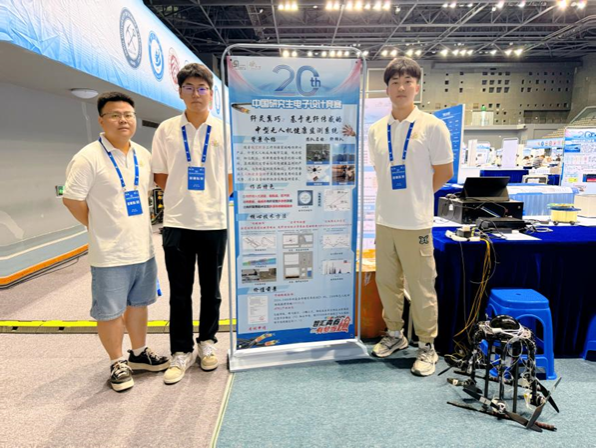
Award-Winning Works Profile
Work Name: "Slim & Smart Wings: Fiber-Optic Sensing-Based Health Monitoring System for Medium-Sized UAVs"
Award: National First Prize
Team Name: Fiber Edge Team
Team Members: Sun Huaze, Lin Wenhao, Ma Zhiqiang
Advisors: Liu Shuo, Zhang Jianzhong
Work Introduction: As low-altitude economy rises to a national strategy, large-scale application of medium-sized UAVs faces challenges in structural monitoring. Traditional inspection methods suffer from low efficiency and poor real-time performance. Based on fiber-optic sensing technology, the team developed a lightweight health monitoring system capable of real-time sensing of structural status across multiple components, including wing rod structures, battery conditions, and motor health. It achieves instantaneous multi-terminal data synchronization and interaction among UAV flight control platforms, desktop terminals, cloud servers, and mobile devices. This innovation transforms UAV operation and maintenance from "periodic inspection" to "condition-based maintenance," providing a new paradigm for digital supervision of low-altitude infrastructure.
Work Name: "Opto-Mechanical Synergistic Sensing — Remote Dental Health Intelligent Detection System Driven by High-Sensitivity Mechanoluminescent Sensors"
Award: National Third Prize
Team Name: KING Team
Team Members: Nan Jinlong, Kang Yujie, Bai Jingyu
Advisor: Wang CiWork
Introduction: Addressing three key pain points in current dental occlusion detection—high cost, low precision, and lack of remote capability—the team designed a remote dental occlusion detection system. Using 2.5D flexible printing technology, multiple flexible energy supply units (mechanical energy generators, bioenergy generators, flexible thin-film photovoltaic cells, and flexible supercapacitors) are integrated with low-power circuits and wireless charging modules on a mechanoluminescent film. The detection platform achieves autonomous energy supply through active and passive modes, with dual-channel bite force signal transmission via photoelectric response. The system enables high-precision multi-region block processing of collected information/images, achieving sub-pixel-level image registration point extraction and detection with an accuracy of over 95%, offering a novel solution for remote oral auxiliary diagnosis and treatment.
Competition Overview
The 20th China Postgraduate Electronic Design Competition officially kicked off in March 2025, attracting 8,228 entries from 333 universities and research institutions nationwide that offer graduate programs in electronic information-related fields. With over 34,000 participating teachers and students, the scale grew by 12% compared to previous editions. After preliminary evaluations across 8 regional divisions, more than 640 teams advanced to the national finals to compete for the top honors.
Sponsored by the Degree Management and Graduate Education Department of the Ministry of Education (State Council Academic Degrees Committee Office) and co-hosted by the Chinese Society of Academic Degrees and Graduate Education, the China Association for Science and Technology Youth Science and Technology Center, and the Chinese Institute of Electronics, the competition is one of the flagship events in the "China Graduate Innovation and Practice Series Competitions." It is a team-based electronic design innovation and practice activity for national postgraduates, enjoying extensive influence among universities and research institutions across the country. The competition aims to promote reform and innovation in the training mode of postgraduates in the electronic information field. This year’s national finals were co-hosted by the People’s Government of Longgang District, Shenzhen, Shenzhen Institute of Information Technology, and Tsinghua University Shenzhen International Graduate School.
The competition showcased the strengths of our school’s postgraduates, including their solid academic foundation, broad vision, and strong hands-on skills, as well as their qualities of being pragmatic, diligent in research, bold in exploration, innovative in practice, and determined to scale scientific heights. Following the school’s first national first prize in this competition in 2024, it has retained the title this year. This achievement marks another breakthrough in the cultivation of innovative talents by the school, reflecting its efforts in recent years to align with national strategic needs, promote the integration of science and education, and support high-quality talent development through high-level scientific research. The school will continue to strengthen the foundation of collaborative education through science and education, translate this success into a strong driving force for future development, and strive to cultivate more top-tier innovative talents.